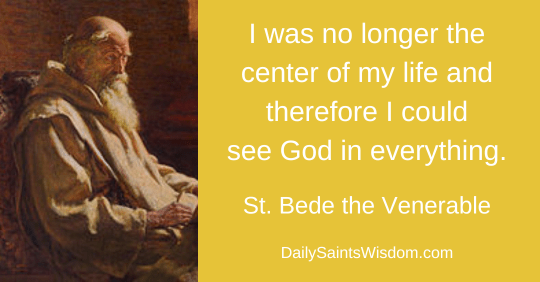
I was no longer the center of my life, and, therefore, I could see God in everything.
St. Bede the Venerable – Benedictine Priest, Doctor of the Church (672 - 735)
Feast Day: May 25th
Be inspired by the saints every day. Just sign up to get inspirational words each day in your email inbox.
About St. Bede the Venerable
St. Bede, commonly known as Bede the Venerable, was an English monk, scholar, and historian whose life and works profoundly influenced the religious and intellectual development of medieval Europe. He was born in 672 in the Kingdom of Northumbria, in what is now northeastern England, in the village of Monkton near Wearmouth. From a very young age, Bede was dedicated to the Christian faith. At the age of seven, he was given to the monastery of Wearmouth-Jarrow as an oblate, a common practice at the time where children were entrusted to monasteries for religious education and upbringing.
Bede grew up in the Benedictine monastic tradition, which emphasized prayer, study, and labor. The monasteries of Wearmouth and Jarrow were centers of learning, boasting extensive libraries and connections with the wider Christian world. Under the guidance of his teachers, including the well-known abbot Ceolfrith, Bede developed remarkable scholarly abilities. He was particularly talented in languages, theology, and scripture, mastering Latin and Greek, the scholarly languages of his time, and demonstrating deep knowledge of Biblical texts.
Bede’s monastic life was characterized by devotion and discipline. As a Benedictine, he followed the Rule, observing strict daily routines of prayer, study, and work. Despite his intense focus on scholarship, Bede was known for his humility and piety. Accounts of his life describe him as a man deeply committed to prayer, often seen reading, writing, or teaching while engaged in spiritual contemplation. His devotion was not limited to the intellectual sphere; he actively participated in the liturgical life of the monastery and served his fellow monks as a teacher and advisor.
Bede’s greatest contributions, however, were his writings. He was a prolific author, producing works on theology, history, science, and Biblical exegesis. Among his most famous works is the Ecclesiastical History of the English People (Historia Ecclesiastica Gentis Anglorum), which was completed in 731. This monumental history chronicles the Christianization of England, from the arrival of St. Augustine of Canterbury in 597 to Bede’s present day. The work provides detailed accounts of kings, missionaries, and religious institutions, offering insights into both the spiritual and political life of early medieval England. It is particularly valued for its careful use of sources and its attempt to place English history within the broader context of Christian Europe.
In addition to historical writing, Bede made significant contributions to theology and biblical scholarship. He wrote extensive commentaries on the Bible, interpreting scripture for both monks and laypeople. His works addressed complex theological questions in a clear and systematic manner, reflecting both intellectual rigor and spiritual depth. He also wrote on chronology and computus—the calculation of Easter dates—demonstrating his interest in science and mathematics as applied to religious practice.
Bede’s scholarship had a lasting influence throughout Europe. His historical methodology, combining critical analysis with careful use of sources, became a model for medieval historians. Furthermore, his integration of Christian theology with the study of history and natural science demonstrated that intellectual inquiry and faith could coexist harmoniously. This approach earned him the title “Venerable” in recognition of his holiness and scholarly achievements, a title that underscores the reverence with which later generations regarded him.
Despite his fame as a scholar, Bede remained deeply humble. He often described himself as a simple monk devoted to God, rather than as a writer seeking personal acclaim. His humility and piety contributed to his reputation for holiness during his lifetime and after his death. He was also known for his concern for pastoral care, instructing monks and the wider Christian community through his writings and personal guidance.
Bede died on May 26, 735, at the monastery of Jarrow. According to tradition, he spent his final days completing his scholarly work, dictating the last chapters of a Biblical commentary on his deathbed. Reports from his contemporaries describe him as dying peacefully, surrounded by fellow monks, fully conscious and serene. His body was initially buried at Jarrow but was later moved to Durham Cathedral, where it remains venerated.
In recognition of his scholarly and spiritual contributions, Bede was canonized as a saint in 1899 by Pope Leo XIII and declared a Doctor of the Church in 1930, making him the first Englishman to receive this honor. His feast day is celebrated on May 25. Bede’s legacy endures not only in the history he recorded but also in the intellectual and spiritual foundations he laid for medieval Europe. His writings continue to be studied by historians, theologians, and scholars interested in the early medieval period, Christian history, and the development of learning in Europe.
St. Bede the Venerable exemplifies the fusion of intellect, faith, and humility. He remains a model of how scholarly pursuit can serve spiritual life and how devotion can coexist with critical inquiry. Through his historical works, Biblical commentaries, and teachings, he preserved the memory of early English Christianity, educated generations of Christians, and shaped the intellectual life of medieval Europe. Bede’s life reminds us that dedication to God, pursuit of knowledge, and service to others can leave a lasting and transformative impact on both the Church and the world.
Read more about St. Bede the Venerable
Feast Day: May 25th
Patron saint of lectors